Inside Stonehenge: Every Stone and Circle Explained
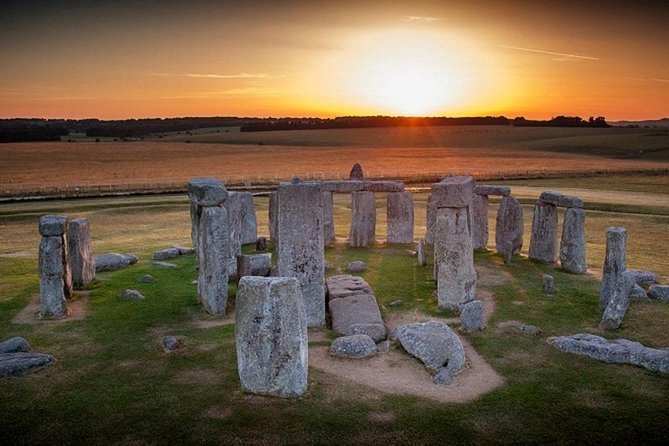
The short version. What looks like one ring is four monuments layered on each other: an outer sarsen circle with a lintel ring, an inner horseshoe of five giant trilithons, two settings of small Welsh bluestones threaded between them, and an earthwork enclosure older than all of it. Knowing which is which is the difference between a photograph and a visit.
The bank and ditch — the oldest thing there
Before a single stone arrived, Neolithic builders dug a circular ditch about 3000 BC and threw the spoil up into a bank inside it. A ring of pits was cut just inside that bank, and cremated human remains were placed in some of them.
You walk over this without noticing. The bank is low and grassed and it is easy to read as landscape rather than architecture. It is the reason Stonehenge is described as a burial ground five hundred years before it became a stone circle.
The sarsen circle — thirty uprights and a ring of lintels
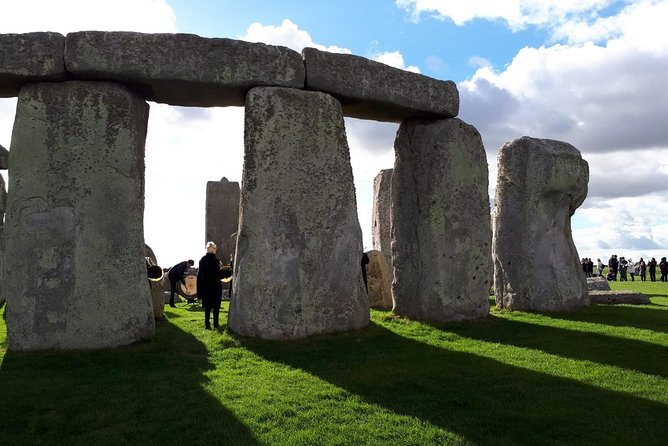
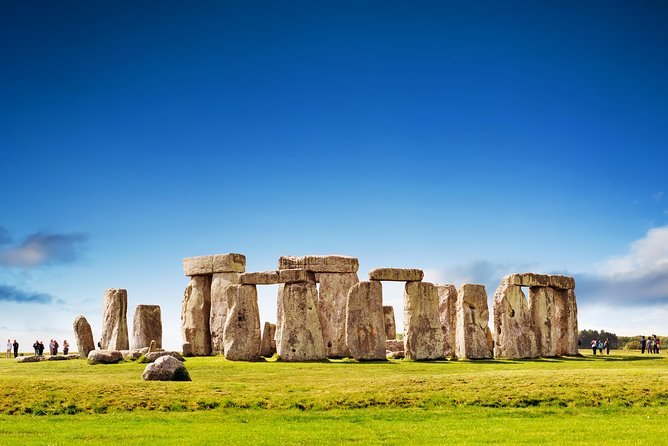
These are the stones in the silhouette. Thirty uprights, each averaging around twenty-five tons, set in a circle and carrying a continuous ring of lintels across the top.
They came from West Woods, south-west of Marlborough, about twenty-five kilometres north, and they were shaped on site with sarsen and flint hammerstones — large ones to flake the surface, small ones to smooth it. Both sizes have been found in the ground here.
Look at the top edge as you walk. The lintels are not simply resting on the uprights: each upright carries a protruding tenon and each lintel a matching mortice hole, so the two lock together. The lintels then join to each other end-to-end with tongue-and-groove joints.
💡 Did You Know? Every one of those joints is a woodworking technique. Mortice and tenon, tongue and groove — carpentry, executed in stone weighing tons apiece, by builders who clearly came from a tradition of timber structures.
The trilithon horseshoe — the five biggest stones
Inside the circle stand five pairs of uprights, each pair carrying its own lintel. A trilithon is literally three stones, and these are the largest at the monument. They are arranged in a horseshoe rather than a ring, opening towards the north-east.
Three still stand complete. The others have fallen or been re-erected, and the great trilithon at the closed end of the horseshoe is the one the midwinter sun sets through. Standing under a complete one is the moment most visitors remember.
The bluestones — the small ones that travelled furthest
Threaded between the sarsens are much smaller stones, two to five tons each, in a darker rock. These are the bluestones, and they came from the Preseli Hills in south-west Wales, over 150 miles away.
The geology is not in doubt: the rock matches Pembrokeshire outcrops precisely. How it crossed that distance is. Hauled and floated by people, or carried east by glacial ice and found nearby, are both still argued, and the argument has been running for a century.
The Heel Stone — the one outside the fence line
Standing alone outside the circle, leaning slightly, is a single unshaped sarsen. It weighs about thirty tons, which makes it the heaviest stone at Stonehenge, and it sits on the axis the whole monument is built around.
It is easy to walk past because it is not part of the ring and it has never been dressed. Look back through it towards the circle and you are looking along the line of the midwinter sunset; turn around and you are facing midsummer sunrise.
The Avenue — the way in
Running north-east from the circle, a pair of parallel banks and ditches heads off across the field towards the sunrise. This is the Avenue, and it is the approach the monument was designed to be entered along.
On a clear day you can trace it from the path. It is also the reason walking in from the visitor centre is worth doing at least once — the shuttle drops you at the side, and the Avenue arrives from the front.
The solstice axis, in one line
Everything above is arranged on a single line. North-east along it is midsummer sunrise; south-west along it is midwinter sunset. A marker set into the path beside the Heel Stone points along it, and it is one of the easiest things on the whole site to photograph.
Which direction mattered more is open. The midwinter alignment is the more precise of the two, and the animal-bone evidence from Durrington Walls two miles east points to midwinter feasting rather than midsummer.
What you can see, and from where
| Feature | What to look for | Visible from the path? |
|---|---|---|
| Sarsen circle | Thirty uprights, lintels across the top | Yes, from every angle |
| Trilithons | Five taller pairs inside the ring | Yes, best from the north-east |
| Bluestones | Smaller, darker stones between the sarsens | Yes, but easy to miss |
| Heel Stone | A leaning unshaped stone outside the circle | Yes, beside the path |
| Midwinter marker | An arrow set into the path surface | Yes, at the Heel Stone |
| The Avenue | Two low parallel banks heading north-east | On a clear day |
| Bank and ditch | A low grassed ring around the whole thing | Yes, once you know |
Seeing it from inside
Everything above is visible from the public path a few metres out. Stone Circle Access, run by English Heritage outside opening hours, admits small groups into the centre — close enough to read the tool marks and the joints rather than infer them. How it works and which departures hold slots is here.
✅ Useful Tip. Walk the circuit twice, once in each direction. From the north-east the trilithons line up behind the outer ring and the monument reads as a solid mass; from the south-west the gaps open and you see straight through. Two hours on the field is what makes that possible.
What is missing, and why
Roughly half the stones you would expect are not there. The lintel ring is broken in several places, several sarsens have fallen, and the bluestone settings are incomplete.
Some of that is collapse over four and a half thousand years. Some of it is quarrying — worked stone standing in an open field was a resource for a very long time before anybody thought of it as heritage. And there is a live argument about whether the outer ring was ever completed on its western side at all, or whether the builders simply stopped.
What that means for a visit is that the monument reads as a ruin from some angles and as a complete structure from others. Standing north-east of it, on the line of the Avenue, is where it looks most like the thing it was built to be.
Why the stones are the colour they are
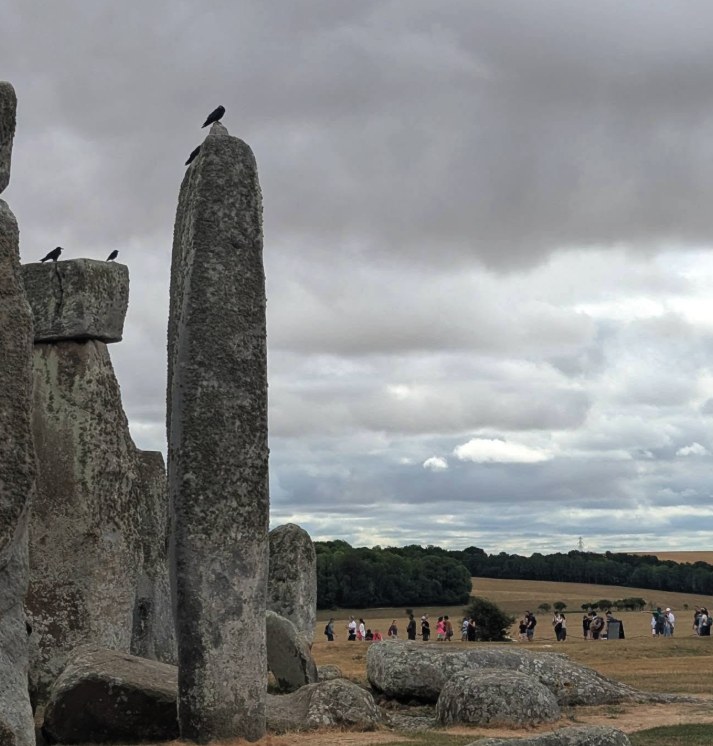
Sarsen is a hard silicified sandstone and it weathers to a pale grey. What gives the surfaces their mottled green and yellow is lichen, growing slowly on stone that has stood in the open air since the Neolithic. Some of it is very old indeed.
This is one of the reasons touching is not allowed, on any visit including the booked access into the ring. Hand oils and rubbing take lichen off faster than it grows back, and a stone touched by a few thousand people a day does not stay the colour in the photographs.
Reading the site on the day
| If you have | Do this | What you will miss |
|---|---|---|
| 1 hour | One circuit, clockwise, with the audio guide | The exhibition, the Avenue, the second light |
| 1.5 hours | The circuit plus the Heel Stone and the marker | The exhibition and the Neolithic houses |
| 2 hours | The circuit twice, then the visitor centre | Very little |
| Inside the ring | The joints, the tool marks and the scale | Nothing — but you still cannot touch |
Whichever you have, the walk-round guide lists what to look for in the order you meet it, and the history page covers each phase in date order. For the practical side — hours, the shuttle and how to get out there — start here.
Want to see the joints rather than read about them? Stonehenge tours from London that give two hours on the field are the ones to look at, and the walk-round guide is here.
Departures that put you closest to the stones
Two that go inside the ring, and the one that gives you longest beside it.